 Addify
SmartUndo+
by Koen Vissers
SmartUndo+
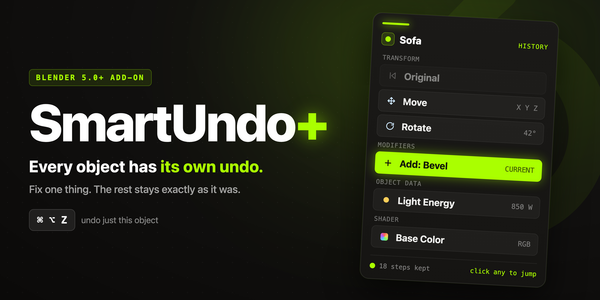
Ctrl+Z rewinds the whole scene, one step at a time. SmartUndo+ gives every object — its own undo history — so fixing one thing never costs you another.
⌥ Z One extra key.
No learning curve.
You already know Ctrl+Z. Hold one more key — Opt on Mac, Alt on Windows — and you're undoing just the selected object. It slots into the muscle memory you already have.
Fixing one thing shouldn’t undo another.
Blender's normal undo rewinds everything in the scene, one global step at a time. Make five small changes to one object while also fixing something else and undoing back to that object means undoing the other work too.
Without SmartUndo+
• One shared undo stack for the whole file
• Easy to lose unrelated work chasing a single change
• No visual history — only one step back at a time
• No way to jump straight to an old state
With SmartUndo+
• Isolated, per-object undo history
• Fixing one thing never costs you another
• A browsable timeline, not a blind rewind
• Jump straight to any earlier step, instantly
Every object, every aspect.
Point at an object or a node tree and undo just that. Each aspect below keeps its own independent track.
Transform
Move, rotate, scale, visibility — split out and labelled per action.
Modifiers
Add, remove, reorder or tweak a param — including nested physics settings.
Constraints
Add / remove / reorder undoable, targets and operands re-linked automatically.
Object data & shape keys
Light energy/colour, camera DOF, curve bevel, shape-key values, pose bones.
Custom properties
Your own scalar and array ID-properties, tracked like any built-in value.
Geometry
Vertex positions, topology, UVs and vertex colours in edit, sculpt and paint modes.
Animation
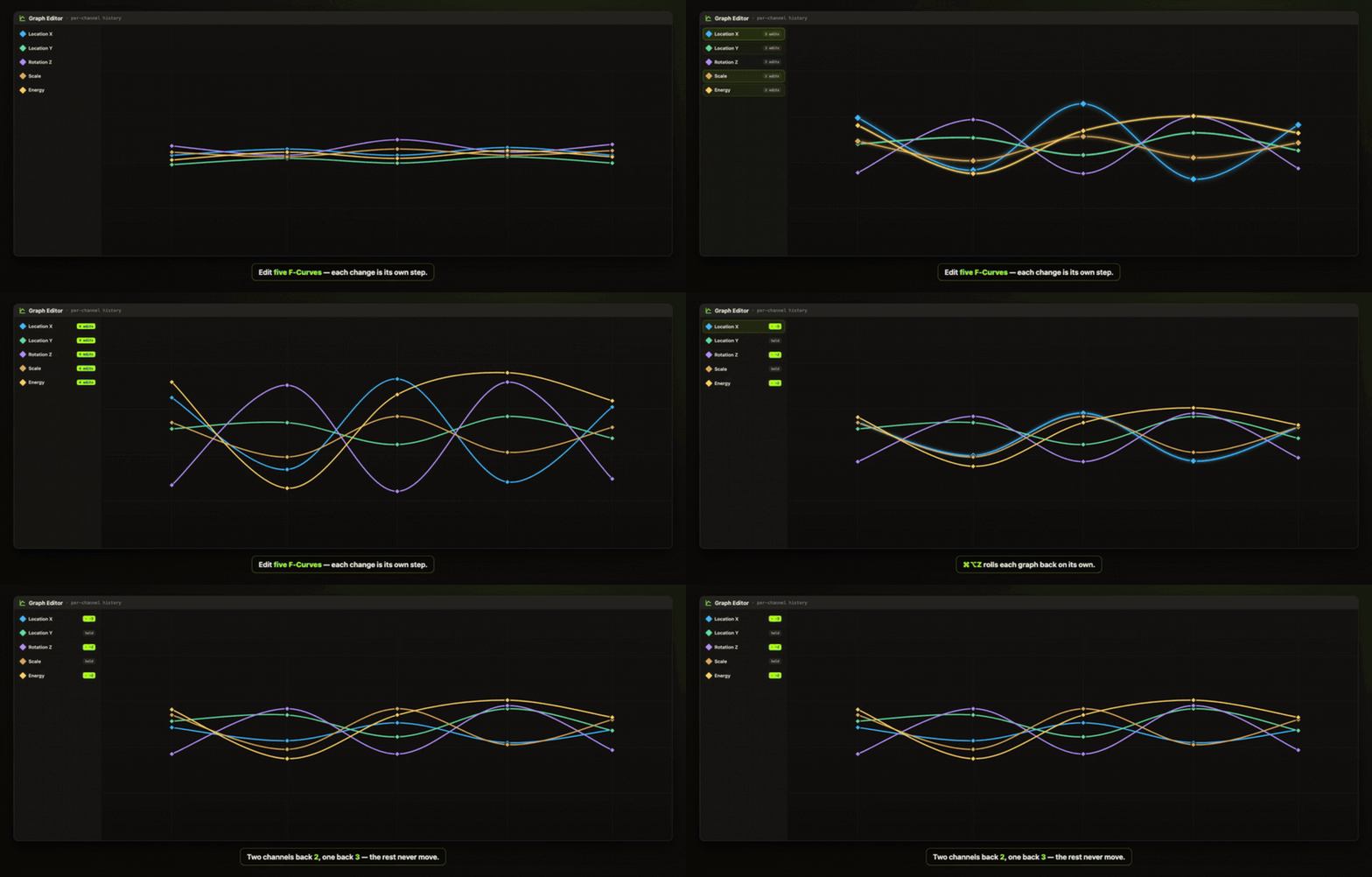
Keyframes are undoable per F-Curve channel — move, add or remove a key, retime a handle, change interpolation — so you can rewind just X Location without touching Y Location. Object channels, shape-key values and material animation, right in the Graph Editor and Dope Sheet. Scrubbing the timeline records nothing.
Shader, World, Geometry-Node and Compositor trees get their own history too — open the Shader / Geometry-Nodes / Compositor editor — or the Graph Editor / Dope Sheet for animation — and the same panel follows what you're looking at. Layers on top of Blender's normal undo — it doesn't replace Ctrl+Z, it adds a second, smarter layer beside it.
See exactly what changed.
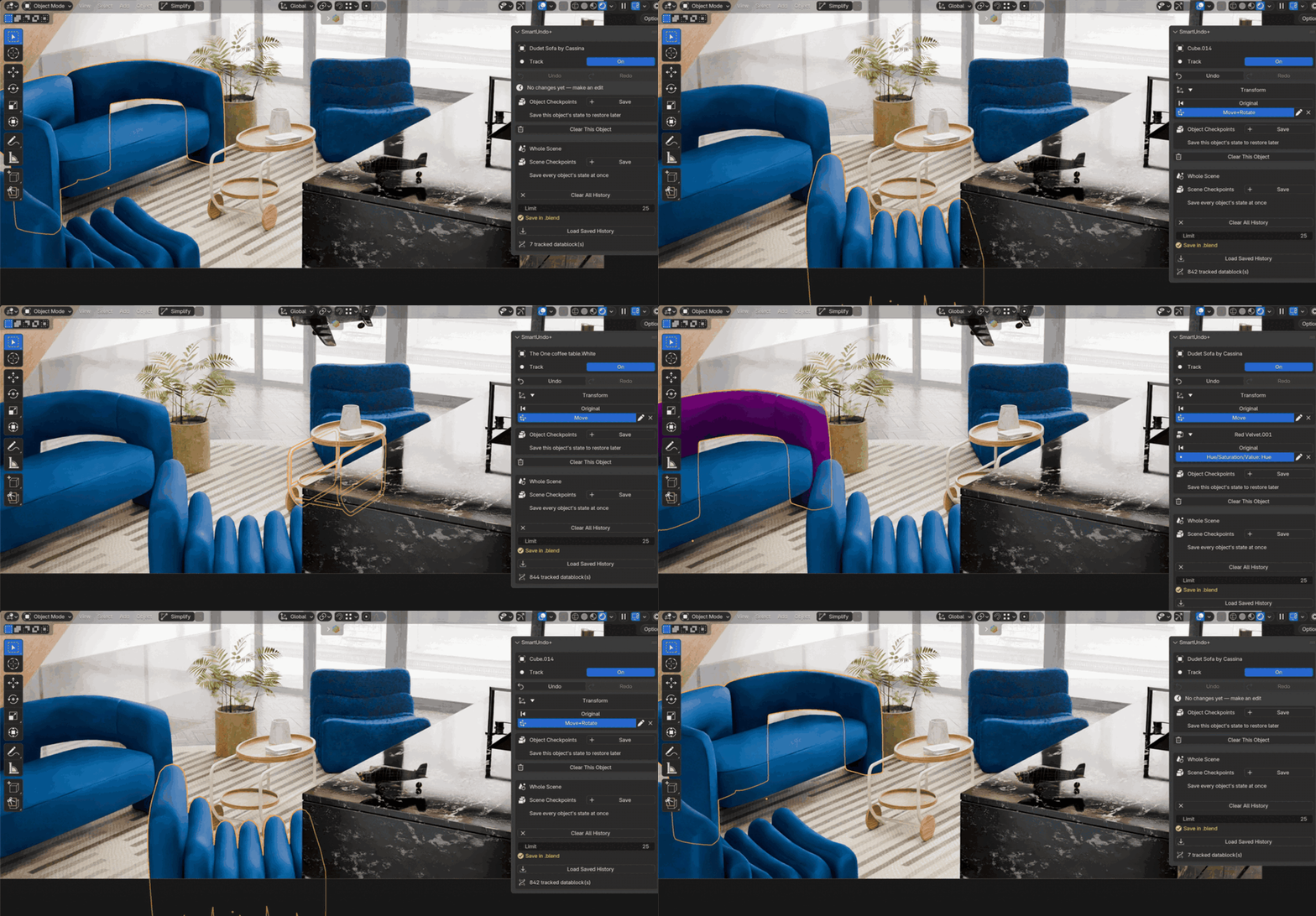
A clear step-by-step timeline per object, grouped by aspect — not just a single “step back”. Select the sofa, a light, a table, a plant — the panel always shows that one object's own history.
Track On/Off per object track only what you're actively working on.
Grouped, independent tracks Transform, Modifiers, Geometry, node trees … each its own timeline.
Click any step to jump straight to that state, no repeated undoing.
Checkpoints named states you save on purpose, per object or whole scene.
Every kind of change. Tracked per object.
Point at any object and its own history is right there — whatever you changed. A sofa's modifier and material colour, a light's energy and colour, a table's position and a custom property, a plant's constraint. Every one on its own track.
Save a state. Come back to it.
Apart from the automatic timeline, save named checkpoints on purpose — for a single object, or for the whole scene at once. Try a bold variation and if it doesn't work out, restore any checkpoint in one click. They're kept in the .blend when you save the file.
Quiet by design. Blazing fast.
Your whole history lives in RAM — the same place Blender keeps its own undo — so stepping or jumping to any state is instant, just like a normal Ctrl+Z. No disk, no waiting; it only writes to your .blend if you choose to save it. And it records a step just once, after a value settles — not on every tick — so it never slows down modeling, sculpting or animating, even on large, complex scenes. You won't notice it's there until you need it.
Selecting a character rig used to cost you frames. As of 1.35.1 the background scan fingerprints each animation channel and only snapshots the ones that actually moved — a 900-curve rig went from 190 ms a pass to 12. Adding more rigs no longer makes it worse. The panel’s RAM figure moved off the redraw path in the same release: editing with the panel open went from +499 ms a frame to +1.5.
As of 1.35.3 the same idea reaches the undo itself. Channels carry fingerprints, so a native undo re-syncs by comparing signatures instead of walking keyframes — a deep history steps back in a couple of lookups, not a full scan. Panel redraws stop re-reading thousands of channel names, the first poll of a big rig is sliced across ticks instead of one long stall, sculpt strokes reuse the previous step’s geometry buffers. Saving pre-warms in the background. Measured with a 900-curve rig and the panel open, each redraw is about half the work it was. Same histories — nothing is lost for speed.
Save history in .blend
Close it today.
Open it tomorrow.
Save your undo history directly into the .blend file. Close Blender, come back tomorrow, load the file — your full history is still there, so you pick up exactly where you left off instead of starting fresh.
Five steps.
Install the extension — drag the smartundo_plus folder (or its zip) onto Blender, or install from disk.
Point at an object in the 3D View, or a tree in the Shader / Geometry-Nodes / Compositor editor.
Press Ctrl+Alt+Z to undo just that object or tree — Ctrl+Alt+Shift+Z to redo.
Open the N-panel → SmartUndo+ tab to browse the full timeline and click any step to jump straight to it.
Optional: turn on Save History in .blend so it's still there tomorrow.
Not a replacement. A second layer.
Worth being upfront about, so you know exactly what you're installing.
SmartUndo+ is not
• A replacement for Ctrl+Z — the global undo still works exactly as before
• Version control or a full scene backup
• Unlimited — each object keeps a capped number of steps, oldest ones drop off
• A way to undo simulation caches, particles or grease-pencil strokes
• An automatic file backup — persistence is opt-in, saved only when you save
SmartUndo+ is
• A second, independent undo layer scoped to the object or tree under your cursor
• A browsable, jump-anywhere timeline per object
• Lightweight — values-only by default, geometry captured only while you edit it
• Bounded on purpose — a configurable step limit keeps it fast
• Optional persistence — you turn it on when you want it, off when you don't
Everything, packed.
smartundo_plus — drag-and-drop install, or Preferences → Add-ons → Install from Disk
Ctrl+Alt+Z to undo, Ctrl+Alt+Shift+Z to redo — independent of Ctrl+Z
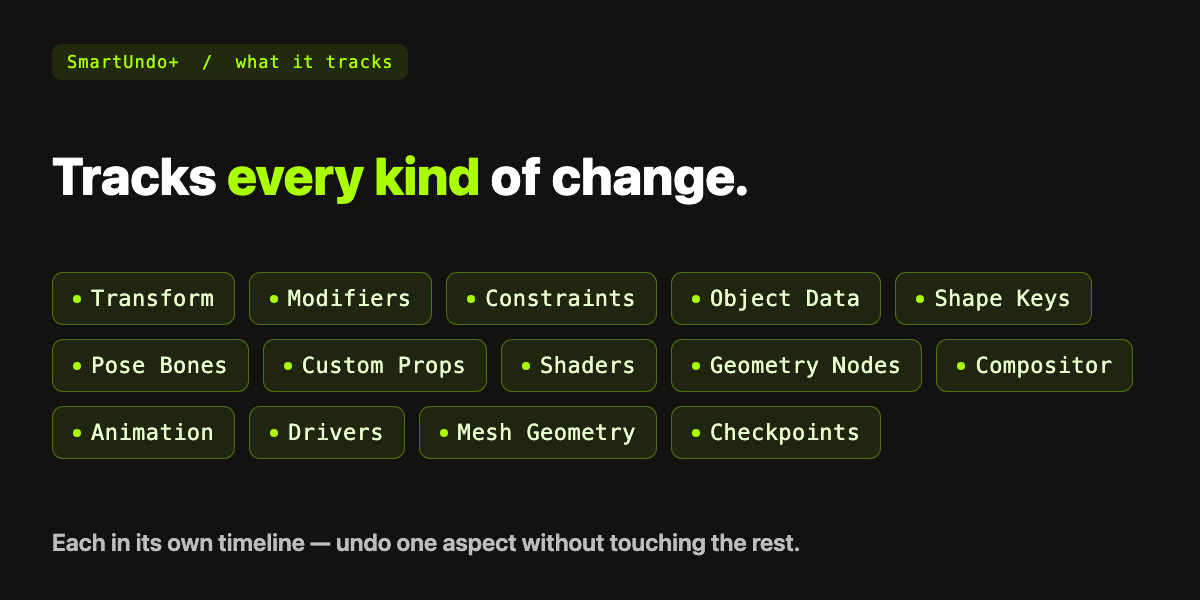
Transform · Modifiers · Constraints · Object Data · Custom Properties · Shape Keys · Pose · Geometry · Animation (per F-Curve) · Shader / World / Geometry-Node / Compositor trees
N-panel, in the 3D View, every node editor and the Graph Editor / Dope Sheet
25 per datablock by default — set a custom limit per object in the panel
Optional — saved into the .blend on file save, loaded back on demand
5.0 or newer
GPL-3.0-or-later